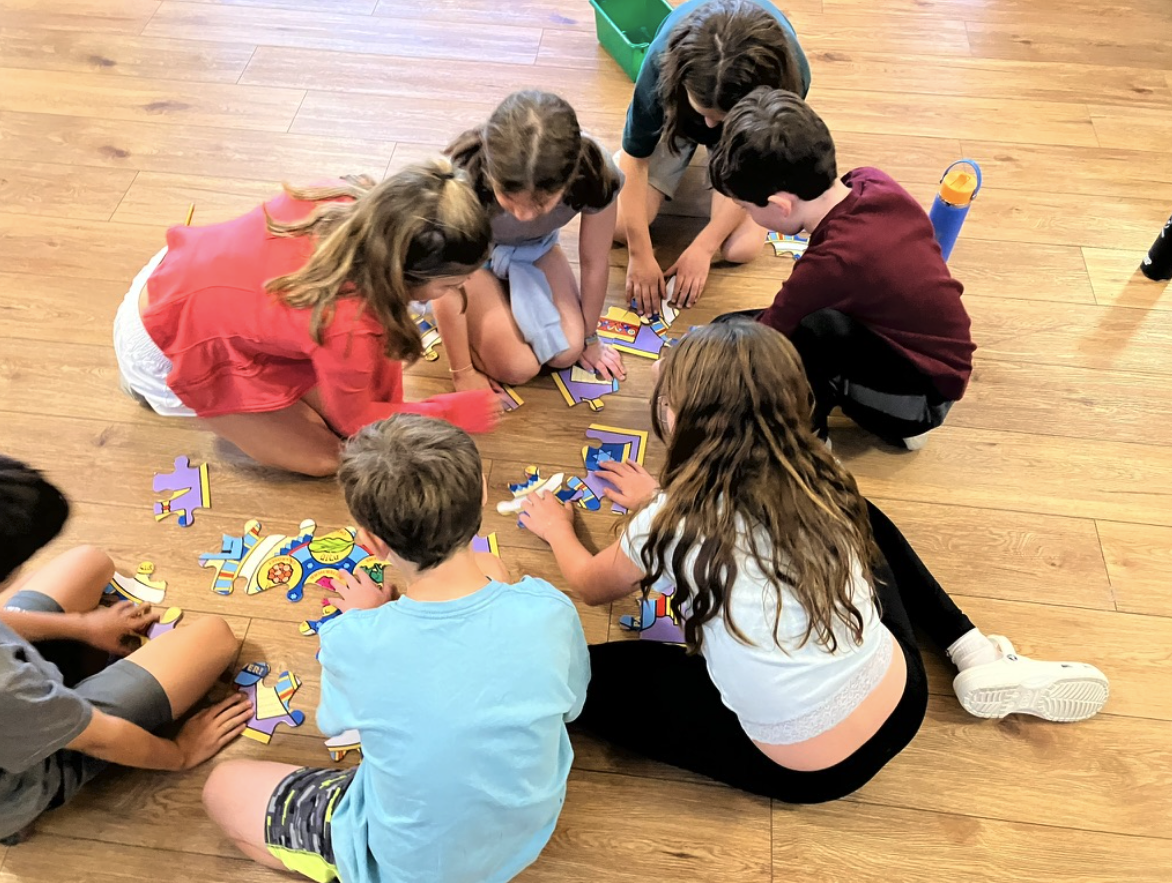
Caption: Students adding pieces as a team to a puzzle as they work on shalom, anchored in shlemut/wholeness.
By Sue Bojdak, independent Jewish educator and consultant.
“Surely, this instruction which I enjoin upon you this day is not too baffling for you, nor is it beyond reach. It is not in the heavens, that you should say, ‘Who among us can go up to the heavens and get it for us and impart it to us, that we may observe it? Neither is it beyond the sea, that you should say, ‘Who among us can cross to the other side of the sea and get it for us and impart it to us, that we may observe it?’ No, the thing is very close to you, in your mouth and in your heart, to observe it.” Deuteronomy 30:11-14
How do we bring the teachings of Torah, our Jewish ethics and values, into our bodies so that the impulse to live a righteous Jewish life is so close that it’s instinctive? Like everything we learn, it takes practice, practice, practice. That is what we did at Congregation B’nai Tikvah (Walnut Creek, CA) in a year-long experiment that we called Playing with Jewish Values.
It began with my frustration about mid-week school tfillah (prayer), which was twenty minutes of theoretically learning about and practicing prayers for kids in grades 3 through 6, at 4:50 on a Tuesday afternoon, wedged between Hebrew learning and electives. No matter how many different strategies we tried, the kids hated it and I hated it. Sitting and chanting or exploring the meanings of prayers was not what we all needed at the end of a long day. We needed to move, explore, and be in community doing the real work of connecting and learning. We needed to play together. Let our perfectly lovely Sunday morning tfillah be our shared weekly prayer space. Dayeinu.
But what to do in that slot? Teachers still needed transition time from Hebrew learning to electives. The kids already had free play an hour earlier when they arrived at the synagogue. What could or should I be doing with them that would be purposeful and active and fun for twenty minutes each week? My inspiration came from a parent leader in the school revisioning work we were working on at the time. She had mentioned a program at her children’s primary school where they had year-long, mixed-age teams who competed in field days throughout the year as a way of building school community across ages, giving leadership opportunities to older students, and creating joy and ruach (spirit). Yes!
When I got the rabbi’s hechsher (seal of approval) for ditching Tuesday tfillah, which she has also found demoralizingly challenging in the years that it was hers to lead, she wondered, “But what will you tell parents the learning is in this new team-building play time?” Instantly I knew it would be about Jewish values, which we had been focused on for a year of Sunday tfillah as our “words of the week” and were now living on the walls of our learning space. Thus, Playing with Jewish Values was born as all great ideas are, organically. We responded to a real stuck spot with child-centered ideas sourced from the community and focused on what feels immediately present and important. The divine inspiration is right here in our brains, in our communities, in our conversations about how to get unstuck.
Playing with Jewish Values is grounded in actual play. We had four mixed-age teams of 10-12 kids (consistent from week to week) who were given a 10-minute challenge to complete as a team. Everyone on the team must participate. We have done 3-legged relays, balanced objects on rudimentary scales, led one another in trust walks, created composite portraits of our teammates, told Jewish jokes and so much more.
Each activity is linked with the value of the day, i.e. nedivut/generosity, simcha/joy, kehillah/community, kavod/respect. At the conclusion of each challenge each team has to work together to articulate the connection, as in “How was generosity necessary to complete today’s task?” Once we made our way through our ten core values, teams shifted to identifying 1-3 values they used that day to complete the task at hand. In the second half of the year, each team had to choose a value and create and lead a challenge for their peers related to that value. In this way we practiced relating our abstract Jewish values to concrete lived experiences of play, collaboration, and the work of being in community with one another.
Teams were deliberately mixed-age and randomized, not chosen by students. The practice is to employ these values with everyone, to work on building connections with people we don’t know, who are hard for us, who feel random. This makes us work harder to build our values muscles while we are also building a broader and deeper sense of our congregational community.
Our teams were also leaderless. The kids have to figure out how to organize themselves week over week. The variety of tasks emphasizes different skills in different weeks so that kids with different skill sets can shine. Part of the work is for the kids to figure out amongst themselves how to tackle the task at hand. Sometimes it worked great. Sometimes it was a hot mess. There were disagreements and bad ideas. There were kids who wandered off or felt excluded. Over time the kids got better at identifying when they were breaking down as a team and figuring out how to recover. They looked out for each other and corrected their mistakes. They reached out to ensure everyone was included. They were doing what my mentor Gail Dorph calls “real work”, which is at the heart of all good learning.
And that “real work” wasn’t just with one another, it was with me too. Almost immediately the kids asked about points and prizes. We color-coded our teams and I devised Hogwarts-style point containers (giant ball jars with colored pom poms) awarding points at the end of each challenge based on some structured rules (10 points for completing the challenge) and some discretionary bonus points (especially good team work today). When one team’s jar was full the kids gave me the ideas for what a good team prize was and then voted on the options I was open to awarding. One otherwise-not-so-engaged student begged for a gaga tournament which became our final 2-week challenge. And when my gaga points and competition plan broke down, they worked together, across teams, to refine the rules until everyone agreed it was fair. From all of this practice they knew what values they wanted on the table, and in the gaga pit.
After a few weeks of students quizzically wondering, “But what about Tuesday tfillah?” we all liberated ourselves into something not just more delightful but more powerful for all of us. Through playful active learning our kids mindfully practiced bringing their Jewish values to life, at synagogue yes, and also so they could bring it into the world, to home, the classroom, recess, the lunchroom, playdates, extra-curricular activities. We used our time together to actively practice so that being our righteous Jewish selves all day, every day is more instinctive; it’s embodied Torah, in our mouths and in our hearts.
About Sue Bojdak
After 25 years leading congregational education programs, most recently at Congregation B’nai Tikvah in Walnut Creek, CA, Sue Bojdak is now an independent Jewish educator and consultant. Learn more about her work here.