By Alisha Pedowitz (she/her), MAEd/MBA, Senior Educator, Jewish LearningWorks
I recall the moment where I actually felt that perhaps I was, indeed, a Jewish educator. Circa 2006, and I had spent the majority of my time so far in the Master’s in Education program at the American Jewish University feeling like I was speaking a different language from most of my classmates. They were all talented educators, the majority of them focused on teaching Jewish literacy. I came to the MAEd program via my work in the camp world, in a cohort with two other like-minded educators in the inaugural year of the concentration in experiential education offered within the larger MAEd program, but where we were mostly studying “classic” Jewish education.
Most of our classmates were speaking about teaching Hebrew, text, and the transmission of knowledge of Jewish lifecycle, holidays, etc. All very important to Jewish education, but the questions I was concerned with were about cultivating the more ineffable elements of Jewish life and practice. For example: the inextricable connection between individual and community; a sense of the sacred as being part of something bigger than yourself; and how Judaism creates pathways for encountering these essential aspects of the human experience.
The majority of classes we sat in together seemed far more oriented toward my classmates’ understanding of Jewish education, not mine, and I found myself often wondering if I belonged there.
And then, in Philosophy of Jewish Education, our professor and Dean Rami Wernik z”l asked us to draw our “vision of God,” and gave us time to silently figure out for ourselves what that meant. Before that moment, I had grappled with the question of whether or not I believed in God, and had come to the vague idea that I believed in the idea that there was a presence greater than each of us individually, connecting us all. Beyond that, I had not explored more deeply what that meant and how it connected to my understanding of Judaism.
But sitting in Rami’s class, and without thinking, I found myself drawing a series of intersecting circles, each composed of many messy lines as I traced back over each one multiple times. When it was my turn to share what I had drawn, I explained that each circle represented an individual person, and what they radiated out into the world around them. And that God was found and seen in the places where the spheres intersected with one another. Godliness is within us all, and the closest we can come to “seeing” the image of God is found in the moments we connect with and encounter that within one another, in the spark that ignites at the intersection. The more those circles are connected and intersecting, the more complete our picture becomes — to the infinite image of humanity in all of its diversity throughout time.
The exercise shifted into focus something that until then I had just intuited; a heightened understanding and awareness of how I experienced the divine in the world. A transcendent moment grew from a simple art exercise: I had never considered my understanding of God in that way, but the activity gave me a space to both explore and articulate it, while deepening my understanding of how I viewed the world, and my place in it. In turn, I began to grapple with how that understanding was a through line throughout my own experiences of Jewish practice, wisdom, and communal participation. I began to look within Jewish text, ritual, and philosophy to find support for this, and to deepen how I understood it. And moving forward, this became the heart of my own philosophy of Jewish education, which has helped inform my practice and pedagogy as an educator: Why does it matter to both see and be seen? How do we cultivate communities and practices that allow us to do both, and enhance our sense of interconnectedness? How do Jewish wisdom, ritual, practice, and community provide us with pathways toward this?
Since that moment in Rami’s class, and for the twenty years since, this understanding has shaped my approach as a Jewish educator.
I felt a similar “aha” moment of deepening understanding listening to Dr. Lisa Miller deliver a keynote on the neuroprotective potential of Jewish education via cultivating spirituality during Jewish LearningWorks’ SoulFULL gathering in February 2025. At one point, she asked everyone in the room to turn to a neighbor and share a transcendent moment, that either they had experienced, or that they had helped someone else experience. Suddenly the room was abuzz.
It was a realization that the spiritually profound moment I had in that classroom, and the attempts to see Judaism as a pathway to experiencing the ineffable, through our daily interactions with self, community, and the Divine, was a language that many Jewish educators were also already finding ways to speak. I am so grateful that, alongside my colleagues at Jewish LearningWorks, we immediately leaned into what that meant and began to organize offerings for educators to further explore the premise of the centrality of spirituality.
I had the honor of facilitating two of the strategies Jewish LearningWorks immediately launched to explore “spiritually-centered Jewish education” in the 2025–2026 year, both of which we are expanding in the coming year due to their impact and success.
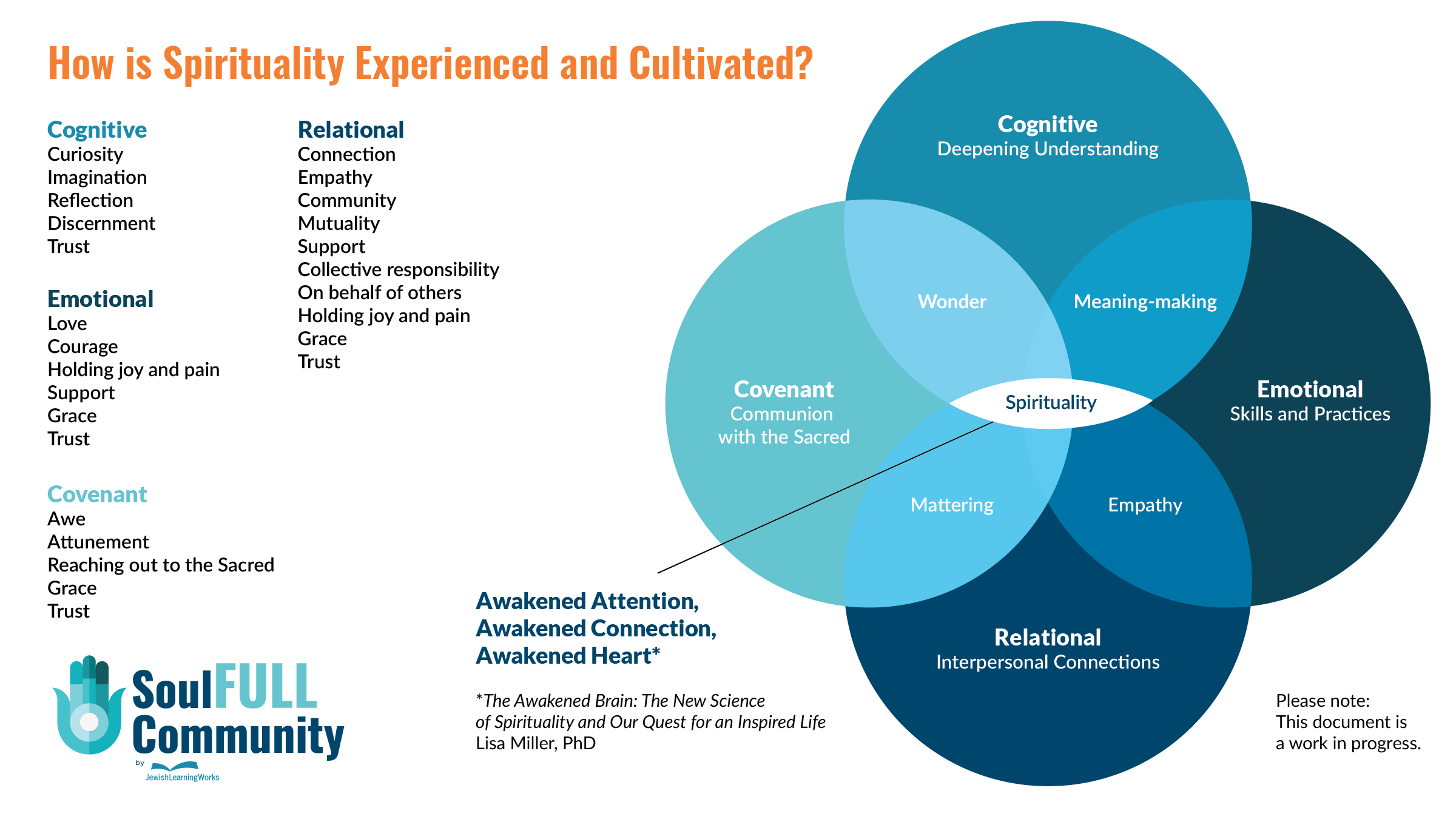
Last year, the SoulFULL Community of Practice for Spiritually Centered Judaism gathered ten Jewish educators who met monthly to explore pedagogy and educational practices that place spirituality at the center of Judaism. These educators included early childhood practitioners to camp professionals to congregational school directors. We began by examining Dr. Miller’s definition of spirituality — “awakened attention, awakened connection, awakened heart” — and the neuroscience research behind that definition. And then we began to pull from different faith leaders and our own approaches as educators, commonalities for how spirituality is experienced, and the educational practices that cultivate it.
With gratitude to my colleagues Evyn Love, Ilene Cohen, Jane Simon, Laurelle Schiff, Melissa Pescatore, Rabbi Sandy Zisser, Shirie Eshel, Sue Bojdak, and Tamar Levin Shamay, we offer this framework in progress to guide our work. We look forward to further refining and exploring it in the coming year in our Community of Practice.
The second new Jewish LearningWorks initiative was the creation of the SoulFULL Sources Collection. For each source, we partner with a different educator or educational organization that is practicing soulful, or spiritually informed, Jewish education. Partners are invited to share their definition of spirituality, and then a teaching practice, lesson plan, or activity that will help learners experience it. These resources are offered as free downloads on our website, with the goal of elevating the many ways these practices might be utilized within the field of Jewish education and engagement. In this way, we are modeling for educators what this can look like, and amplifying the profiles of the professionals and places who are doing it. We added five resources to the collection in our first year, and throughout this coming school year we will continue to add at least five more.
Why does all of this matter? As I wrote in an OpEd following Dr. Miller’s keynote in our February 2025 SoulFULL gathering:
“Miller’s research points to a new way of addressing [the current societal mental health] crisis. She sees it not as a crisis at the individual level, but as a crisis of the public sphere. In her view, that crisis should be understood as a spiritual one. In former Surgeon General Vivek Murthy’s ‘Parting Prescription for America,’ he called the eroding sense of community a key factor in the ‘epidemic of diseases of despair.’ His prescription is to build community through relationships, service, and purpose,’ which is essentially a framework for the spiritual experiences that Miller’s research points to — a framework that Judaism can provide.”
Jewish LearningWorks has been so inspired by what we have learned and seen this past year in our deep dive into spirituality and its impact that “Placing Spirituality at the Heart of Jewish Education” is one of the five central goals of our newly adopted strategic plan titled “The Cornerstone of a Thriving Jewish Future.”
I encourage educators to go back and look at the framework that my SoulFULL Community of Practice colleagues and I have shared in the graphic above. I hope you will see a variety of pathways to the very idea Murthy articulated — community built through relationships, service, and purpose — reflected within it. Now, imagine Jewish educators using this as we plan to intentionally cultivate this framework within our classrooms and learning communities. Where Jewish text, wisdom, tradition, ritual, and practice is used as the pathway to do so. In this vision, we as educators hold a valuable key to nurturing a healthier and thriving world, as well as the individuals within it.
As I close, I will return to where I started: sitting in Rami Wernik’s Philosophy of Jewish Education course, drawing those intersecting circles as I explored my understanding of the Divine. It strikes me that the overlapping circles I imagined way back in Rami Wernik’s course show up again in the graphic the SoulFULL Community of Practice created. The magic is in how and where the individual circles overlap, and what is created — yet each circle on its own is essential. I invite you to be part of our growing, interconnected circle of Jewish educators learning with and from one another about how to center the ineffable within Jewish learning — and why it matters. Please reach out so we can explore how we can intersect.