Critical Conversations for Jewish Education
Online, In-Person
Democracy & Antisemitism
Critical Conversations for Jewish Education is a new learning series designed to help educators explore the challenges most alive in America today, and how they affect children, teens, and families. We will examine how and why we, as Jewish educators, can help create space for essential conversations about democracy and antisemitism – topics that can feel too complex in an increasingly polarized climate, yet demand our full participation and humanity.
When: Sessions run from August 2026 to January 2027.
Where: In-person sessions in the Bay Area, and online sessions.
Hillel used to say: in a place where there are no people, strive to be a person.
Pirkei Avot 2:5
This series will lean into nonviolent communication as the foundation of our learning and conversations together. In the workshops on democracy and antisemitism, we will consider how to help each other, and our learners, have the critical conversations taking place in our classrooms and communities today.
- Aimed at: Educational leaders, teachers and administrators. Open to professionals working with learners of all ages, across educational settings.
- Series structure:
- A required foundational workshop that introduces nonviolent communication as a tool to address moral questions. Online and in-person options available.
- Two workshops focused on democracy and antisemitism. You may select one or both workshops upon registration. Each workshop includes online and in-person sessions.
- A closing online workshop.
- Facilitated by Alisha Pedowitz, Senior Educator, Jewish Learning Works. The workshops will be led by:
- Kathy Simon, Ph.D, communications expert and non-violent communication certified trainer.
Aaron Dorfman of A More Perfect Union.
- Rose Silverman, social and racial justice organizer.
- Dr. Tara Liberman and Dr. Sasha Soykin of the Jewish Community Mental Health Initiative.
- Natalie Boskin, M.A, talmudist and torah teacher.
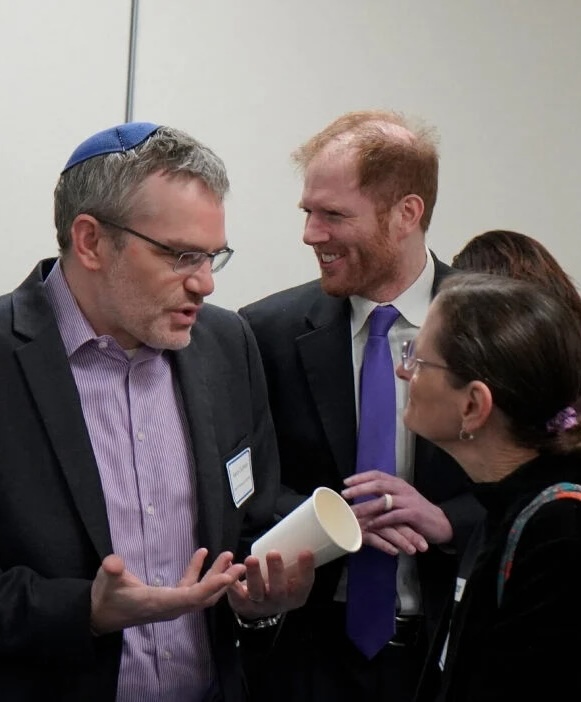
Aaron Dorfman speaks with Rabbi Elana Kanter at an election center in Arizona. Photo credit: MCTEC.
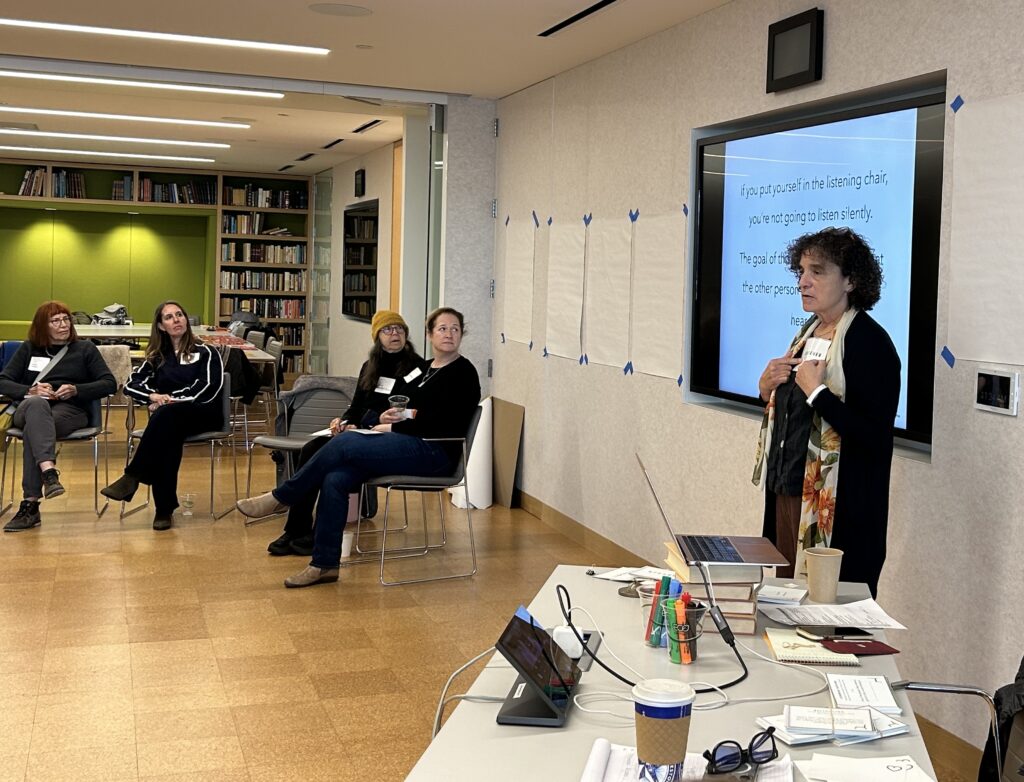
Kathy Simon leads a non-violent communication workshop for Bay Area educators at Jewish Federation Bay Area.
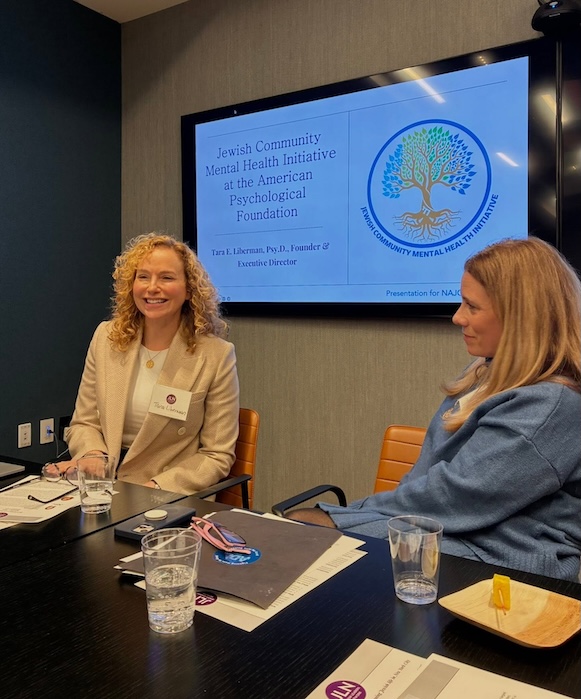
Tara Liberman presents the Jewish Community Mental Health Initiative.
Learning Arc & Program Details
Required Foundational Unit: Moral Questions in the Classroom
Critical Conversations for Jewish Education is built around the discussion of questions that are crucial for our community, but that can also be challenging. The more skill we bring into these conversations, the more fruitful they can be. Together, we’ll build a communications foundation to approach potentially controversial topics for us as educators, and our students. We will practice:
- Framing issues as questions to focus on ongoing inquiry rather than immediate side-taking
- Listening to divergent views to build our curiosity and empathy muscles
- Not having an answer for every question posed by our students, and use these moments to prompt further curiosity and critical inquiry
Three opportunities to attend:
- Tuesday, August 25, 2026 (10 am – 1:30 pm) at Congregation B’nai Tikvah (25 Hillcroft Way, Walnut Creek, CA 94597)
- Tuesday, October 6, 2026 (12:30 – 2:30 pm PT) Online
- Thursday, December 3, 2026 (10 am – Noon PT) Online
We strongly encourage you to attend in-person if you are able. All sessions led by Kathy Simon, Ph.D, communications expert and non-violent communication certified trainer.
Attendance is required at one of the Moral Questions in the Classroom workshops to opt for any of the workshops that follow this series.
Critical Conversations About Democracy
American democracy is under growing strain. Polarization, declining trust, attacks on elections and rising extremism threaten a system that has enabled remarkable progress for nearly 250 years.
The Jewish community, alongside many other communities, has found a home in America, and that shared experience carries both opportunity and responsibility. In this two-part workshop – pre- and post- midterm elections – we will consider the role Jewish organizations have to play in helping children and teens understand the importance of protecting democracy. Together we will explore:
- What is our responsibility as Jewish educators to protect democracy?
- What role does democracy and civic engagement play in Jewish education?
- Why is democracy relevant to Jewish education?
- What values and skills should we be cultivating with our students to help uphold a democratic system?
Two sessions:
- Tuesday, October 20, 2026: This pre-elections session will focus on the abstract questions and whys of our responsibility as Jewish educators.
- Time: 10 am – 1 pm
- Place: East Bay Jewish Community Campus (5957 Chabot Rd., Oakland, CA 94618)
- Monday, November 16, 2026: This post-elections session will dive into what our responsibilities are going forward, and what those responsibilities look like in Jewish education and Jewish learning.
- Time: 10 – 11:30 am PT
- Place: Online
These conversations will create respectful space to address and acknowledge different perspectives and political options in order to be curious with one another, ask questions, and explore how we in turn do the same for our students – all of which are essential skills for upholding the promise of democracy.
Both sessions will be led by Aaron Dorfman of A More Perfect Union.
Critical Conversations About Antisemitism
This interactive training equips you with the knowledge and practical strategies needed to recognize, understand, and effectively support Jewish students and families in the face of rising antisemitism.
In the first session, participants will explore and discuss language and frameworks for their own understandings of antisemitism and its intersection with other important issues in this moment in time. We will also explore the Dismantling Antisemitism Guide as a resource and tool for use in our classrooms and educational settings. In the second session, participants will explore the psychological impacts of antisemitism and practical approaches to supporting Jewish students and educators.
While centered on the experiences of Jewish students, the principles discussed are broadly applicable to supporting all students affected by bias, discrimination, and identity-based harm.
Two sessions:
- Thursday, December 17, 2026: Standing Up Against Antisemitism while Building Solidarity, led by Rose Silverman, social and racial justice organizer.
- Time: 10 am – 1:30 pm
- Place: Congregation Am Tikvah (625 Brotherhood Way, San Francisco, CA 94132)
- Thursday, January 7, 2027: The Psychological Impacts of Antisemitism, Jewish Resilience, and the Power of Community led by Dr. Tara Liberman and Dr. Sasha Soykin of the Jewish Community Mental Health Initiative.
- Time: 10:30 am – Noon PT
- Place: Online
Optional Closing Lunch & Learn
This closing unit will ground our learning with discussions about applications.
- Tuesday, January 26, 2027
- Time: 12:00 – 1:30 pm PT
- Place: Online
- Led by Natalie Boskin M.A, talmudist and torah teacher.
All Critical Conversations workshop series participants are encouraged to attend.
Registration
Jewish LearningWorks offers all of our programs at a subsidized rate due to the generous support of our donors. As an organization that primarily serves the San Francisco Bay Area, and receives funding support from donors in the Bay Area, we are happy to offer an additional 18% subsidy to educators who live in the 9 Bay Area counties and/or work for organizations that primarily serve the 9 Bay Area counties (Alameda, Contra Costa, Marin, Napa, Santa Clara, San Francisco, San Mateo, Solano, Sonoma).
Enrollment Fees
Bay Area Organizations: The cost for participants from Bay Area organizations is $218 for the whole series, or $144 per workshop.
Non-Bay Area Organizations: The cost for participants from Bay Area organizations is $260 for the whole series, or $170 per workshop.
The required foundational workshop, and the optional closing lunch and learn are offered at no-cost for all participants.
Registration is open until the program is full.
Registration for Bay Area Jewish Youth Resilience Roundtable Members
Organizations that are members of the Bay Area Jewish Youth Resilience Roundtable receive one comped registration for the following session:
- Thursday, December 17, 2026: Standing Up Against Antisemitism while Building Solidarity, led by Rose Silverman from 10:00 am to 1:30 pm at Congregation Am Tikvah in San Francisco.
If you are a member, please email Alisha Pedowitz at alisha@jewishlearning.works to register.
Questions
Please contact Alisha Pedowitz, Senior Educator, at alisha@jewishlearning.works for any questions or more information.
All trainings at Jewish LearningWorks are subsidized by our generous donors. If the cost is a barrier to your participation, do not hesitate to contact us.
About Our Presenters
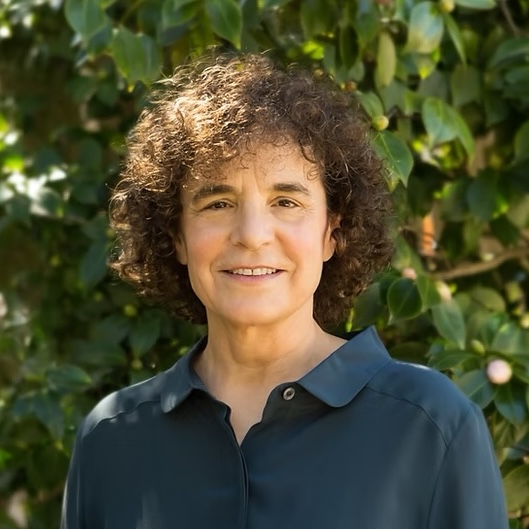
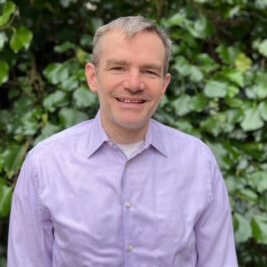
Aaron Dorfman is Founder and Executive Director of A More Perfect Union: The Jewish Partnership for Democracy. Prior to launching A More Perfect Union, he served as President of Lippman Kanfer Foundation for Living Torah, Vice President for Programs at American Jewish World Service, and Director of Informal Education at Temple Isaiah of Contra Costa County. Aaron serves on the Advisory Board of the Safety Respect Equity Network and on the board of Policy Impact. He lives in Brooklyn, New York, with his wife Talia Milgrom-Elcott and their three daughters.
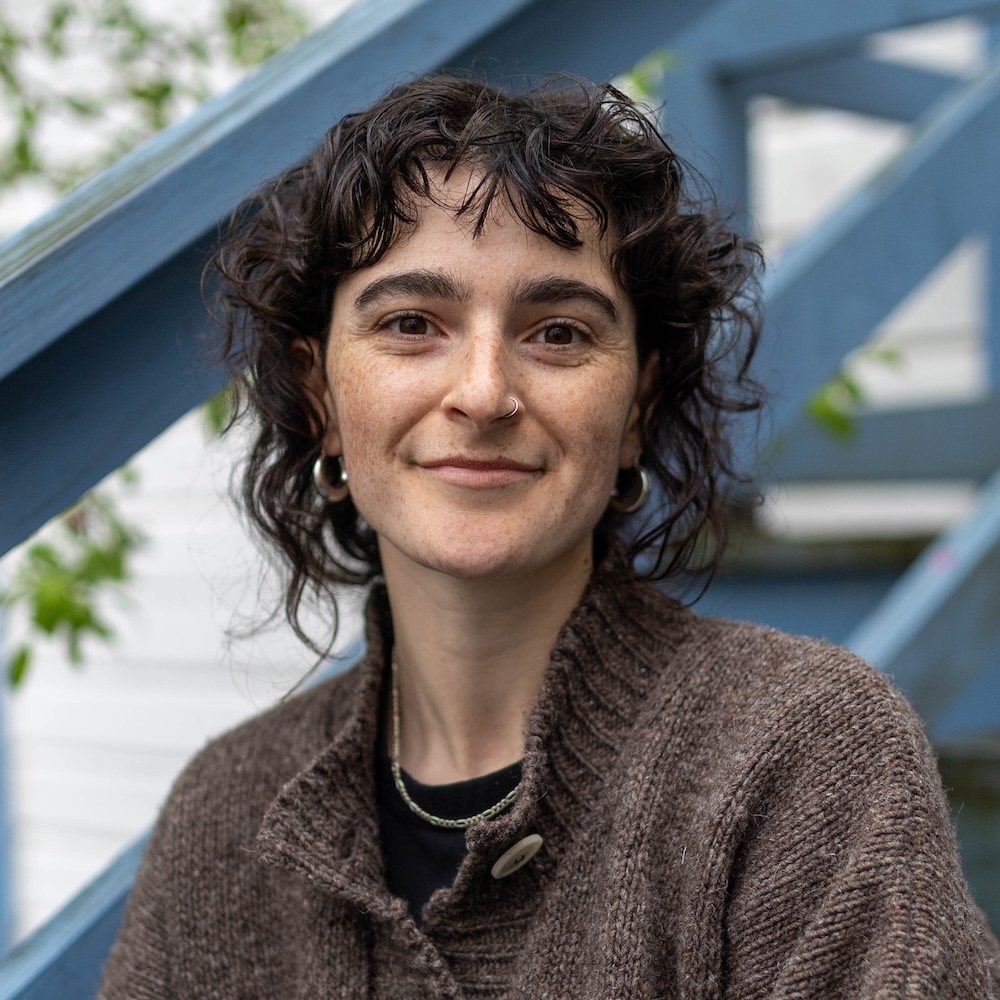
Rose Silverman is a facilitator, trainer, and capacity-builder, having spent the last eight years working with local and national Jewish organizations to strengthen their anti-oppression and political education programs. She is currently the Program Manager for the Collaborative for Jewish Organizing, a network of nine independent Jewish organizations working in 16 states and the District of Columbia, organizing Jews and non-Jewish allies to work to advance social, racial, and economic justice, building power for the long term. In her role with the Collaborative, Rose is focused on leading their work fighting antisemitism. Rose previously worked as a consultant with the Jewish Council on Urban Affairs (JCUA) to support their anti-racism training programs. She was the Chicago Senior Program Director for Avodah, supporting young Jewish adults in building the tools needed to sustain justice work. While at Avodah, Rose also designed and led Avodah’s first-ever antisemitism training for organizational partners. She continues to consult on this project. Rose is based in Chicago and uses she/her pronouns.
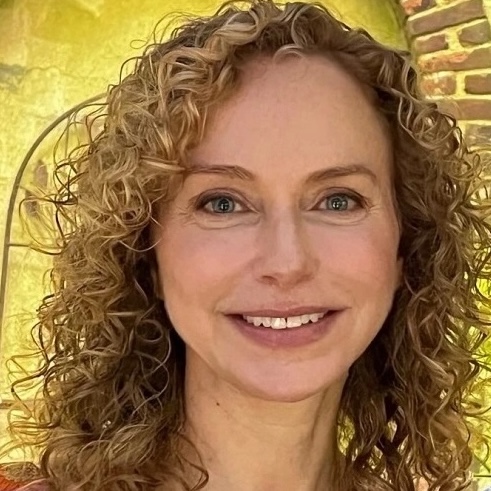
Dr. Tara Liberman (Jewish Community Mental Health Initiative) is a licensed psychologist in private practice in New York City, specializing in psychotherapy with children, adolescents, and adults. She serves on the faculty of the Child and Adolescent Psychotherapy Training Program at the William Alanson White Institute, where she teaches and supervises psychology and social work trainees. She is a candidate in the NYU Postdoctoral Program in Psychotherapy and Psychoanalysis. Throughout her career, Dr. Liberman has partnered with both public and independent schools as an in-house psychologist and consultant, helping school communities navigate crises, process collective loss, and foster healing and resilience.
In the weeks following October 7, 2023, Dr. Liberman led the grassroots effort that became the Jewish Community Mental Health Initiative (JCMHI), mobilizing and training mental health professionals to provide free, trauma-informed virtual support groups for the Jewish community. Under her leadership, JCMHI has grown into an international initiative advancing the mental health and resilience of Jewish communities through direct support, research, and education on the psychological impacts of antisemitism and identity-based hate. Dr. Liberman serves on the Collaborative of Jewish Psychologists at the American Psychological Association and on the leadership committee of the International Jewish Association of Trauma Therapists. She is a frequent speaker and educator on the psychological impacts of antisemitism, identity-based hate, trauma, resilience, community healing, and post-traumatic growth.
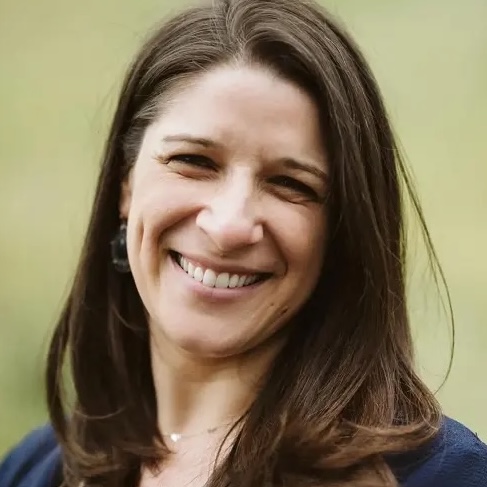
Dr. Aleksandra (Sasha) Soykin (Jewish Community Mental Health Initiative) is a licensed clinical psychologist in private practice in the Bay Area, California, specializing in trauma, grief, chronic illness and pain, and health psychology. She is a founding member and Director of Operations of the Jewish Community Mental Health Initiative (JCMHI), where she oversees clinical operations, program development, volunteer clinician engagement, and strategic initiatives. Since JCMHI’s founding following the events of October 7, 2023, she has helped lead its growth into an international initiative providing free, clinician-led support groups, educational programming, research, and rapid response efforts for Jewish communities worldwide. Dr. Soykin develops and delivers trainings and presentations on the psychological impacts of antisemitism and identity-based hate, trauma, resilience, community healing, and supporting Jewish individuals and communities during times of collective stress.
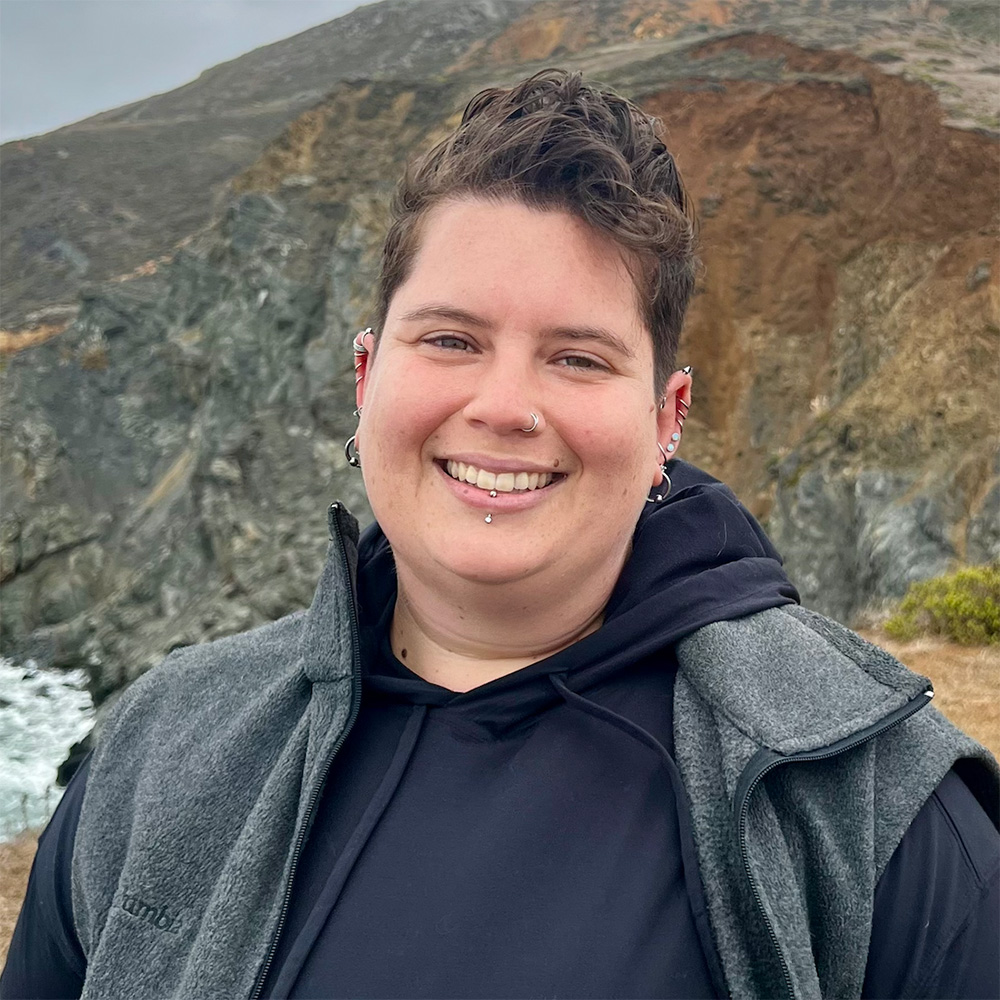
Natalie Boskin‘s love for torah has brought them to straddle the academic and yeshiva worlds. They are passionate about weaving historical criticism with rabbinic interpretive traditions to participate in diasporic Jewish thought and life. Natalie strives to unlock pathways towards a liberating Jewish future by naming and dreaming beyond the systems of domination that have shaped and shine through Torah, while refusing to abandon her. Natalie holds an MA in Jewish Studies from the Graduate Theological Union, is a faculty fellow at SVARA: a traditionally radical yeshiva, was in the second cohort of the Voices for Good fellowship, and has over a decade of experience as a Jewish educator.